
(5 minute read)
All private sector businesses have to focus on business development (BD) and sales to stay alive, and professional services firms are no different. New work doesn’t just happen. Consulting leaders usually have a substantial sales and BD responsibility alongside their chargeable work; and that’s not surprising, given consulting is all about managing and growing client relationships.
This article looks at the concept of business development in management consulting, and the important principles that help drive strategic sales decision-making.
Because they include repeatable processes, there are aspects of business development that lend themselves to systemisation. Indeed, medium to large consultancies no doubt have a Customer Relationship Management (CRM) system, e.g. Salesforce, to capture and process BD and sales related data. Systemising the BD process is a good thing as long, as we don’t lose sight of the key concepts around business development and sales.
“Systemising the BD process is a good thing as long as we don’t lose sight of the key concepts around business development and sales”
The BD Lifecycle
Lets start with a look at the Business Development lifecycle, and consider the formal steps of how consulting firms think about progression of opportunities to formal engagements.
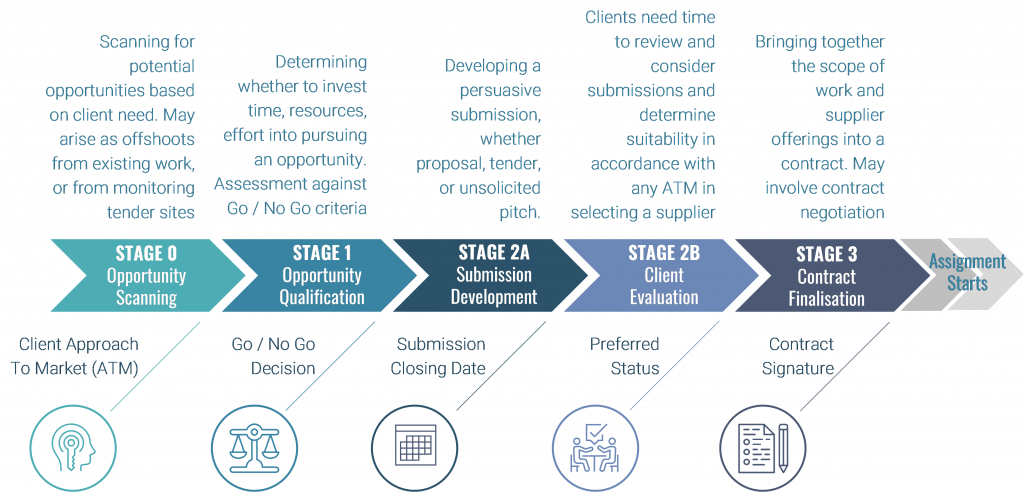
The formal process can be time consuming and demanding on limited time and resources. But if you’re systemising it, its important to standardise the language and definitions around staging. Remember, BD and sales involves a filtering process. Clients naturally run formal Approach To Market processes that allow them to filter out the competition. Similarly, consulting leaders make important filtering decisions, particularly at the Go / No Go stage on which work is best to pursue. We’ll look at how consultants make Go / No Go decisions in a separate article.
Referrals and Repeat Business
Formal tender submissions can be costly, high risk and time consuming, but necessary if you’re looking to break into new market segments. Most consulting leaders will tell you that the best form of business development is through leveraging referrals and repeat business. Clients look for suppliers who can quickly understand their business, and who represent low risk because they’ve been tried and tested before.
“Most consulting leaders will tell you that the best form of business development is through leveraging referrals and repeat business”
So progression through the BD lifecycle can jump quickly from an initial conversation at Stage 0 through to a light touch proposal (Stages 2A and 2B), and rapid engagement (Stage 3). No matter how fast or informal, the engagement will still inevitably pass through the same stages in some form.
A Probabilistic Approach
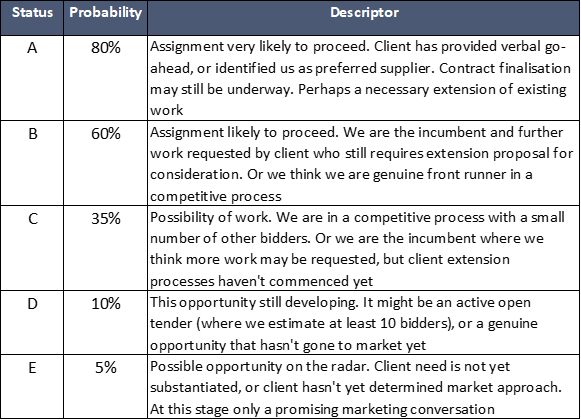
Aggregating all opportunities across the lifecycle allows a forward “pipeline” of work to be developed, and this lends itself to a simple framework for assessing the likelihood that a particular opportunity may materials into chargeable work.
Here’s a typical model using opportunity status indicators. The status of an opportunity may or may not align with the Stage in the BD lifecycle we discussed above, but often it does.
Managing the Pipeline
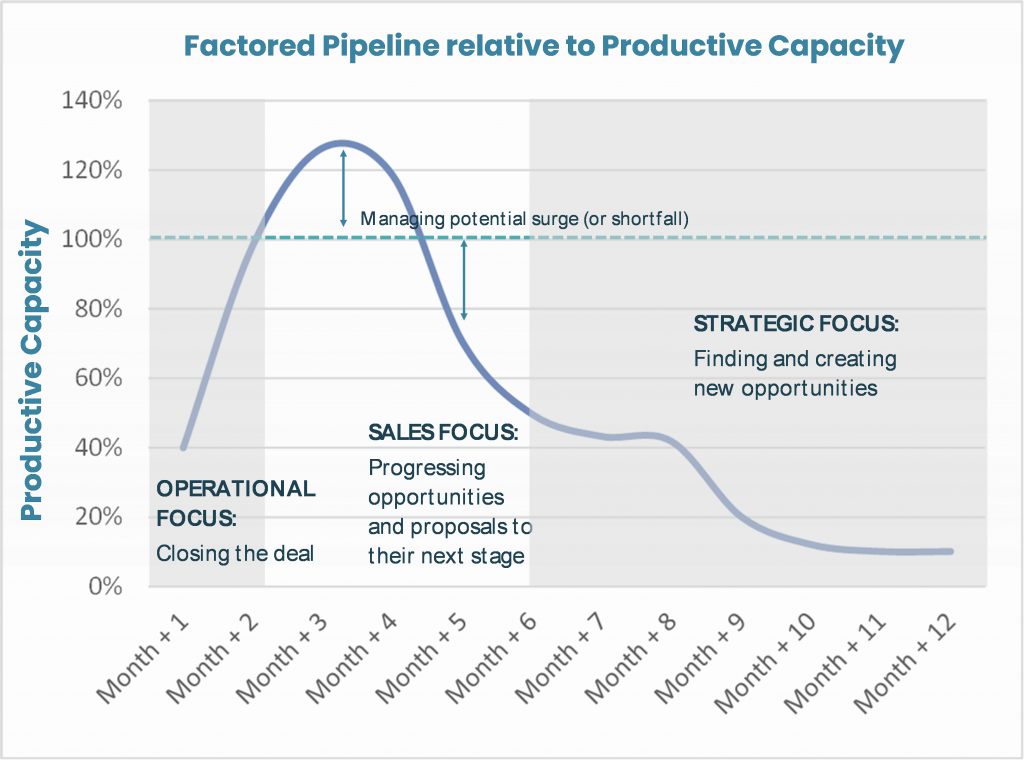
If we know the potential magnitude of the assignment (in terms of say revenue), and factor this by the opportunity likelihood, we can build up a realistic, measurable profile of forward business. This is often referred to as a “Factored Pipeline”
And if we compare that pipeline to the availability of resources in the business (i.e. the productive capacity), we have a tangible basis for making informed tactical, operational and strategic decisions about pursuing new work. This is summarised in the following figure.
Summary
Managing and monitoring a pipeline of forward work is critical to successful business management, and in the daily remit of consulting leaders. In our consulting workshops, we’ll provide more detail and worked examples of how to build a forward pipeline, and use it to inform key business decisions.
Dr Nigel Nutt
Founder and Principal
Tabiya Services Pty Ltd
www.tabiya.com.au
The views and concepts presented in this article are the intellectual property of Tabiya Services Pty Ltd. All rights reserved. The article may be forwarded or recirculated as long as the article remains complete, and attribution to Tabiya Services is retained.